Season 5 Episode 2: Your O face


In this episode we continue our conversation based upon Chapters 3 & 4 of Lucy Cooke's book Bitch: on the female of the species. We started off the conversation doing a deep dive on the famous Bateman experiment that purported to reveal 3 principles concerning variation in male and female reproductive success and how those differences drive sexual selection. After reviewing the experiments and what they were reported to show, Sarah then discussed some more recent papers that closely re-analyzed the original 1948 experiment and how that revealed critical flaws and biases in the study which weakens the strength of its conclusion.   We were left with thinking it is more Bateman Hypothesis than Bateman's Principles. 

Once we established that it is not correct to characterize females as being coy and unwilling to mate more than once, we explored the reasons why females would exhibit a level of promiscuity that rivals that expected from males. We discussed the orgasm as a feature in sexual activity and how scientists have tried to characterize this physiological response in other non-human primates. 
Image of O face adapted from drawing in Bitch from Chevalier-Skolnikoff's research.


We had a spirited conversation about the evolution of the female orgasm and how it might influence females seeking multiple mates. 

We ended the podcast with a discussion of sexual cannibalism. We explored the reasons why, in some species of spiders, the males are so much smaller than the adult females which facilitates her eating the male. Although killing and eating a potential mate seems maladaptive, we discussed the various reasons why it may be adaptive for the female and for the male to kill or be killed. 
Post mating cannibalism in a web building spider. Image from Schneider 2014 


The opening theme to Discovering Darwin is "May" by Jared C. Balogh. http://freemusicarchive.org/music/Balogh/Revitalized_Eyes/MAY


Interlude music
Girls Just Want To Have Fun. Song by Cyndi Lauper
Maneater. Song by Hall & Oats

Season 5 Episode 1-Incubated in misogyny

We have returned from a long hiatus to discuss a wonderful book entitled Bitch: On the Female of the Species by Lucy Cooke. Sarah asked James and Mark to read this book that gives an updated look at Darwin's original model of sexual selection, a topic we covered extensively in Season 4. In this episode we cover the introduction and first 2 chapters of the book.

In our conversation about the book, we discuss how Darwin's stereotypical, and simplistic. views of male and female roles in mating and reproduction have persisted 150 years later. As Sarah says, we are still suffering from the hangover Darwin's misogyny. Chapter one of the book does a great job challenging the simplistic notion of what "is a female?", and we explore that topic in detail. Mark was enamored with the existence of gynandromorphs (gyn=female, andro=male, morph=form), organisms that exhibit both male and female phenotypic structures. This led us to discuss the difference between sex and gender and why the simplistic view, often exposed in popular culture of late, of there being only 2 sexes, is incorrect and ignores actual biology. 

Image taken from https://www.eriebirdobservatory.org/ebo-blog/2021/2/21/a-second-bilateral-gynandromorph-northern-cardinal-in-northwest-pennsylvania

We also discuss how stereotypical gender roles influence how biologists interpret the behaviors they observed which often leads to misunderstanding and faulty interpretations. We encourage our listeners to read along with us, as we plan to discuss Chapters 3 & 4 next episode. 

Lucy Cooke (Photo: David Dunkerley)


Here is another example of gynandromorphs, but in butterflies.

Image from https://www.earth.com/news/gynandromorphs-half-male-half-female/


The opening theme to Discovering Darwin is "May" by Jared C. Balogh. http://freemusicarchive.org/music/Balogh/Revitalized_Eyes/MAY     

Interlude music

Bitch Song by Meredith Brooks

Sage Grouse calls were from Greater Sage-grouse strut display 
https://www.youtube.com/watch?v=m0M8pZnNlnI


Season 4 Episode 10: Darwin is WRONG! Click here to learn more


In this final episode of Season 4, Mark, Sarah, and James finally critiqued Darwin's analysis of secondary sexual characteristics in humans and his clumsy attempt to apply his model of sexual selection in explaining the diversity of forms in what Darwin called "races" and we call geographically distinct phenotypes (GDPs). We found that Chapters 19 & 20 of Descent of Man distilled and concentrated Darwin's most ethnocentric and sexist observations and pseudo-scientific explanations concerning the differences between the sexes and GDPs. 

Image from Wilson, Miller, and Crouse (2017)

Sarah made the argument that human sexual dimorphism, differences in size and body form of males versus females, is the smallest of all seen in extant primates. Sarah questioned why Darwin tried to assign those slight differences to sexual selection. James made the argument that there are two categories of traits that Darwin was discussing. James referred to the physical traits, like hair color, skin color, height, facial shape, etc. are intrinsic traits you inherit genetically. Humans also exhibit extrinsic traits, hair styles, piercings, tattoos, clothing, etc. which you inherit culturally. 

Mark explained the complexity of beauty and why attraction and beauty are two different issues. We explored how specific standards of beauty are locally determined and how how diverse they can be across the globe. Both James and Sarah independently concluded that Darwin's model of sexual selection was not sufficient in explaining the creation of the great diversity of human forms seen between the geographically distinct phenotypes around the world. Sarah invoked founder effects and genetic drift, non selective processes, in creating genetically distinct populations that were then acted upon by local selective pressures, both from the environment and within the social group. It is through those processes Sarah thought created the geographically distinct phenotypes, and not through sexual selection. James agreed and thought that selection at the group level, where everyone in the social group, enforced phenotypic norms on others through infanticide and cultural practices of shunning or killing undesirables created the diversity of forms seen among the GDPs.  Sarah and James' models do not require the extreme level of sexual selection and polygyny required in Darwin's model to shift the phenotype of the entire population. Also, the social cohesion model of selection can allow for rapid shifts in the phenotype as the entire social group enforces the phenotypic norms instead of just the mating male and who he selects to mate with. 

The opening theme to Discovering Darwin is "May" by Jared C. Balogh. http://freemusicarchive.org/music/Balogh/Revitalized_Eyes/MAY     

Interlude music

You are so beautiful - Joe Cocker (1974)
I'm too sexy - Right Said Fred (1992)


Season 4 Episode 9: Love Antics and Conspicuous Ornamentations


After a long COVID induced hiatus, we have returned to tackle the meaty middle of Charles Darwin's magnum opus The Descent of Man. It was actually most of Volume 2, three hundred and nineteen pages of anecdotes, observations, wild conjecture, and chuck'splaining his crazy system of inheritance. The dense plodding Victorian prose was diluted, a bit, by the amazing woodcut prints of beetles, fish, lizards, exotic birds whose feathers were stolen by Victorian women, and ornamented antelopes and other mammals. 

Human female adorned with decorative feathers stolen from birds

Mark covered the fish, amphibians, and reptiles, since James forgot to assign the invertebrates, we did not discuss the myriad beetle examples Darwin discussed. However, Mark was impressed with the ways in which fish, during the breeding season, become so brightly colored. We mentioned a local fish, the male rainbow darter, which is quite striking during the spring breeding season. Mark was surprised to learn that there is no such thing as a fish and Sarah encouraged him to read Why Fish Don't Exist: A Story of Loss, Love, and the Hidden Order of Life – by Lulu Miller

Rainbow darter male

Mark expressed his disappointment in the lack of sexual dimorphism in snakes, an animal group he has an inordinate fondness for. Although we did not discuss the invertebrates, James brought up the interesting sex determination system in slipper shell molluscs (pictured below) and how the top individual becomes the male, and all the ones below shift to be female. 


James tackled the immense bird section and offered a variety of hypothesis why the males of a species may look different than the females, in addition to Darwin's model of sexual selection and female choice. We also discussed the unique sex chromosome system in birds and how that is opposite of what we see in mammals and how some scientists believe it helped accelerate and magnify sexual dimorphism in birds. 

Fig. 47. Paradisea Papuana (T. W. Wood).


Sarah covered sexual dimorphism in mammals and noted that Darwin believed most of that dimorphism was created through male-male battles for access to females and less about female choice. We had a lengthy discussion of antlers and horns and how they sometimes show up in both sexes but often is only found on the males. Sarah also discuss African lion manes and how they vary in shape and color where the darkest mane is the one most successful in fights and securing mates but there are costs with having the mane. 
A lion with a very dark mane

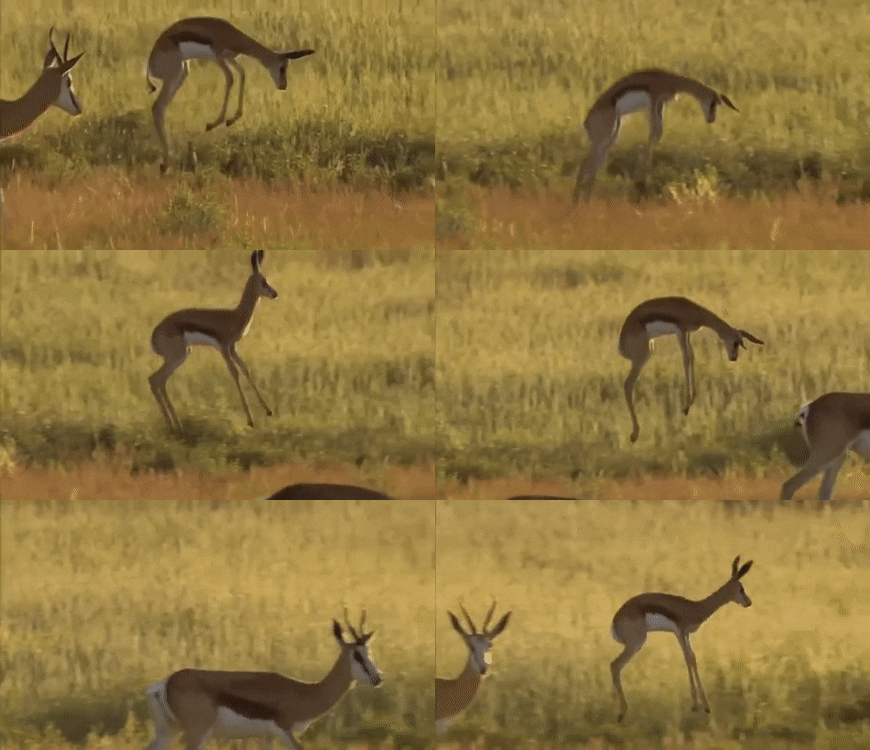
We also discussed the odd stotting behavior of some ungulates, as shown in the gif below. 


The opening theme to Discovering Darwin is "May" by Jared C. Balogh. http://freemusicarchive.org/music/Balogh/Revitalized_Eyes/MAY

Interlude music
Fat Caps by Jason Shaw
https://freemusicarchive.org/music/Jason_Shaw/Audionautix_Tech_Urban_Dance/TU-FatCaps/

Love Cats by the Cure

Season 4 Episode 8: Sexy time and selection


In this episode we dive into Chapter 8 from Darwin's Descent of Man. James incorrectly attributed this chapter to the end of Volume I of the two volume set but it is actually the first chapter of Volume II, which makes more sense given its dramatic shift in focus and topic. Sarah tried to get us to differentiate between adaptive traits that come about from sexual selection with those that come about from natural selection.  

Photo from https://rollingharbour.com/2017/02/14/bluehead-wrasse-private-life-laid-bare/

We spent some time discussing the difference between sex-linked traits, like calico cat color,  and sexually selected traits like the giant antlers on the extinct Irish Elk.  James presented just a few hypothesis that have been proposed to explain female choice of traits and why those traits that females seem to prefer are often opposed by natural selection. It is hard to be a red male cardinal in the dead of winter. Sarah suggested interested listeners read The Evolution of Beauty by Richard O. Prum to learn how to differentiate the products of sexual and natural selection. 

We had a robust discussion about sex and gender and what Darwin knew at the time and what he should have acknowledged about the lack of binary distinction in the sexes. Mark realized he misspoke when he said that the rate of disorders of sexual development are around 10%. Data suggests that it occurs more like  (1:2500–5000 live births) whereas gender dysphoria is reported to occur around 0.002-0.014%. The bluehead wrasse is a wonderful organism that challenges the simple-minded view that your sex is determined at birth. 


https://www.bbc.com/news/av/uk-northern-ireland-45449128

Sarah also encouraged us to watch some Green Porno to learn more details about the sex lives of non-human animals. You can see it here


The opening theme to Discovering Darwin is "May" by Jared C. Balogh. http://freemusicarchive.org/music/Balogh/Revitalized_Eyes/MAY 


Interlude music is Alberta Hunter singing My handy man ain't handy no more from her Amtrak Blues album.

Bonus Episode - Are Angels moral?


image from:https://www.artsales.com/ARTistory/angelic_journey/index.html

In this bonus episode we return to our conversation with our favorite ex-monk philosopher friend Dr. Jack Furlong where he discusses whether angels, as described in scripture, could actually be moral.  We then briefly discuss the Yale baby lab where clever behavioral experiments are done on human babies to see how early they exhibit cognitive decision making. We hope to be back in the studio to record a complete episode out soon. 

Season 4 Episode 7: We are Many, We are One

 In this episode we finally confront Chapter 7 of Descent of Man,  entitled On the Races of Man. In this  chapter Darwin discusses the races of humans and outlines the scientific arguments of the time that questioned if humans are more than one species.  These arguments, of course, were based upon racist European views of the people from the lands their countries had colonized. Race is a social construct, not a biological identity, and we discussed why that is the case in this episode.  


https://angelicadass.com/photography/humanae/
James Wagner's daughter participated in this awesome art project and she is included in the images above.


At one point we noted that Darwin reintroduced the idea of a range of varieties of organisms that can interbreed along a geographical range, but the ends of the ranges were reproductively isolated. We introduced that idea, often called a ring species, in Season 1 Episode 3, which can be found here

Sarah loves her ectoparasites and their evolution and discussed Darwin's 30 year obsession with that issue. Here is a link to a wonderful series of articles about Descent of Man and that obsession.


The opening theme to Discovering Darwin is "May" by Jared C. Balogh. http://freemusicarchive.org/music/Balogh/Revitalized_Eyes/MAY 

Interlude music is We are Many, We are One a song from Up With People, a group of musicians who "stage song and dance performances promoting themes such as religion, racial equality, and positive thinking." Our own Mark Jackson played trumpet with Up With People before pursuing his career in psychology.