Season 1 Episode 14: Chapter XV - Recapitulation and Conclusion


In this episode we discussed Chapter XV - Recapitulation & Conclusion from Darwin's Origin of Species. It is our final podcast of this season and we chose not to recapitulate as much as discuss how Darwin's book was received at the time and how Darwin handled the release of his book.

Although only 1250 copies of Origin of Species was published in the first edition, Darwin purchased 80 or so copies himself and Mudie's Circulating Library purchased 500 copies for use in their subscription service library, a service widely used by many middle class British folk.

It was through the subscription library that allowed Darwin's ideas to be widely distributed to the general public while fevered debates occurred in churches and academic halls.

The original 1859 publisher of Origin of Species was the Murray Publishing House book and the publisher was very generous in allowing Darwin to make corrections after the first printing run which is why the 2nd edition of OoS has a 1860 publication date.

We discussed how Darwin was often portrayed as an ape in cartoons published at the time. When we discussed the infamous images of monkey-like Darwin James erroneously associated those images with the famous Punch magazine but it turns out the ones he was thinking of came from other magazines of the time.
Charles Darwin considering the fashion of the time - the bustle (Fun magazine 1872)


 from The Hornet magazine, 1871


We really appreciate you listening to our podcast and we hope you return later this fall when we return with Season Two - Darwin the Adventurer.

The opening and closing theme to Discovering Darwin is "May" by Jared C. Balogh. 

Interlude music is bensound retro soul

Season 1 Episode 13: Chapter XIV Embryology


This episode discusses Chapter XIV where Darwin applies his ideas of evolution and descent with modification to explain the developing "natural system" of classification, the unity of embryos and why organisms have rudimentary or vestigial organs.  

Classification
From the most remote period in the history of the world organic beings have been found to resemble each other in descending degrees, so that they can be classed in groups under groups. This classification is not arbitrary like the grouping of the stars in constellations. The existence of groups would have been of simple significance, if one group had been exclusively fitted to inhabit the land, and another the water; one to feed on flesh, another on vegetable matter, and so on; but the case is widely different, for it is notorious how commonly members of even the same sub-group have different habits.

Cuvier in 1817 proposed a system of classification that recognized animals as belonging to one of four forms  - Vertebrata, Mollusca, Articulata (arthropods) and radially shaped animals (Radiata).
image from http://www.buffalolib.org/content/milestones-science/georges-cuvier
Darwin argues that the hierarchical system of classification mirrors his idea that new species formation mirrors the pattern of inheritance and genealogy we see in family tree. 
 A nice example is the phylogeny of placental mammals, those are mammals different from marsupial mammals (kangaroos, opossums, etc.) and monotremes (egg laying mammals like platypus)  in that they retain the embryo internally in a placental sac where they feed and protect the developing embryo. Placental mammals represent the majority of extant species of mammals today and seem to have evolved from three major geographical locations - Africa, Laurasia and South America. This is a a beautiful artistic representation of the placental mammal phylogenetic tree.
http://eurwentala.deviantart.com/art/Eutheria-345487389

A comparison of early development of placental mammals from the Afrotheria clade (left most branch) shows similarities and divergences in the different types of mammals.

 [A.. Tenrec [tenrecoidea], B. Golden mole [Chrysochloridae] C. Elephant shrew [Macroscelididae] D. aardvark [Tubulidentata] E. Bush elephant [Proboscidae] F. dugong [Sirenia] G. hyrax [Hyracoidea] Image from Hautier, Lionel, et al. "Patterns of ossification in southern versus northern placental mammals." Evolution 67.7 (2013): 1994-2010.

Modern phylogeny and classification is based on Darwin's ideas of descent with modification and we now use DNA, RNA, and protein sequences to expand and improve our understanding of the relatedness of organisms

Embryology

We have seen that the members of the same class, independently of their habits of life, resemble each other in the general plan of their organisation. This resemblance is often expressed by the term "unity of type;" or by saying that the several parts and organs in the different species of the class are homologous. The whole subject is included under the general term of Morphology. This is one of the most interesting departments of natural history, and may almost be said to be its very soul. What can be more curious than that the hand of a man, formed for grasping, that of a mole for digging, the leg of the horse, the paddle of the porpoise, and the wing of the bat, should all be constructed on the same pattern, and should include similar bones, in the same relative positions?

Homologous bone structure of tetrapod limbs

James attempted to differentiate homologous structures from analogous structures but showed how complicated it can be when discussing flying adaptations in mammals. As you can see in the figure above, the limbs of birds, bats, humans, seals and turtles contain the same bones in the same configuration making them homologous in morphology. What changes in the relative size to each other not their relative position. In vertebrates, the evolution of powered flight occurred independently three times - in Pterosaurs (reptiles), bats (mammals), and birds (again reptiles) so their wings are functionally analogoussince they are wings constructed of different specific materials. James erroneously said that the pterodactyl wing was from a super elongated index finger but in fact it is the 4th digit what we associate with the pinky finger.  We colored the figure below of a pterodactyl wing to conform to the color legend in the figure above.

Embryology

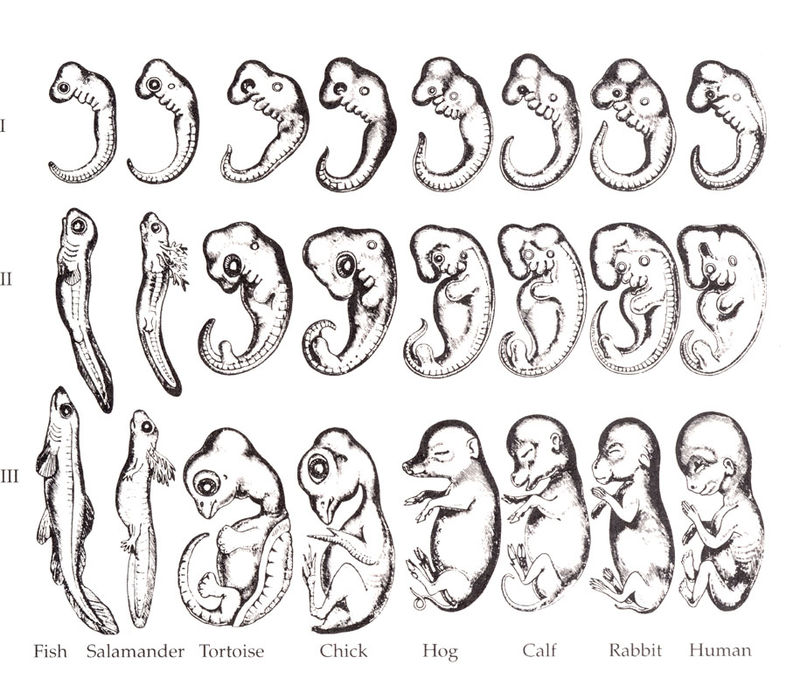
Earnst Haeckel was a famous scientist in Darwin's time who applied Darwin's idea of the evolution of organisms in his studies of the embryonic stages of chordates

As Sarah mentioned this set of illustrations were updated but the overall conclusion does not differ. Follow this link to read a wonderful summary of the Haeckel embryo controversy with modern drawings and interpretation. Overall embryo development does show that chordates exhibit very similar and distinct stages of development whereas the adult forms can be quite different in form.

Rudimentary Organs
 Humans exhibit a number of traits, that we see in other mammals, but are degraded or rudimentary in their form. Some classic examples we discussed were the coccyx (tail bone), wisdom teeth and appendix but failed to mention the degrading nictating membrane in the corner of our eyes. In other chordates it is semitransparent film that can over the eye to clean and protect it. Ours is reduced to a little nubbin in the corner of our eye.
http://www.bio.miami.edu/dana/pix/nictitans.jpg

The opening and closing theme to Discovering Darwin is "May" by Jared C. Balogh. http://freemusicarchive.org/music/Balogh/Revitalized_Eyes/MAY

interlude music is Otrov by Black Bear Combo http://freemusicarchive.org/music/Black_Bear_Combo/

Season 1 Episode 12: Geographical Distribution: Chapter XII-XIII


In this episode we gather our liquid strength and courage to work our way through two chapters of Origin of Species, Chapter XII - Geographical Distribution and Chapter XIII - Geographical Distribution continued.  Although Sarah predicted the podcast would last 3 hours we luckily were able to restrain ourselves to 1 hour and 28 minutes.

We do have two corrections to make-
#1  Although Josh declared that Noah's Ark came to rest on the top of Mt. Sinai the general view is that it actually settled on Mt. Ararat.

#2 James mentioned the relationship between flightless birds (ratites) and the breakup of paleocontinent of Pangea when he should have said Gondwanaland instead.

Chapter XII-XII
These two chapters have been present in OoS since the first edition and it is in these chapters that Darwin defends his model against the prevailing view of the time - special creation. To make his argument Darwin uses modern distribution patterns of plants and animals on continents and islands, the success of introduced species to new habitats, experiments he conducted at Down House and data he collected from citizen scientists.

Geographical Distribution 

There is hardly a climate or condition in the Old World which cannot be paralleled in the New—at least as closely as the same species generally require....Notwithstanding this general parallelism in the conditions of the Old and New Worlds, how widely different are their living productions!

Sarah discussed the idea of the monkeys from Africa (Old World Monkeys) are quite different from the monkeys found in South America (New World). In Madagascar are found the prosimians "almost monkeys" like lemurs, aye-aye, and sifakas.

By Joseph Meyer - MKL online at Retro Bibliothek, work 149, 2009, Public Domain, https://commons.wikimedia.org/w/index.php?curid=2598452

On the continent of Africa are a large diversity of primates that range from leaf-eating species like the colobus monkeys to the generalist species like the vervet monkeys and baboons.  In addition gorillas and chimps which are tail-less apes are also in Africa (we realize that these are not monkeys but they needed to be mentioned none-the-less).

www.discovery.com
The New World monkeys are quite different in form, long limbed with many species having a prehensile tail which they can use as a 5th limb.
http://www.wildernessclassroom.com/students/archives/2005/03/spider-monkey.html

Josh talked about the rich diversity of marsupial mammals found in Australia, the most striking is(was) the Tasmanian Wolf, a marsupial carnivore that looks like a dog but it is more closely related to a kangeroo! Here is a haunting silent 1936 film of the last known living Tasmanian wolf filmed in captivity.
 

James discussed Darwin's interest in the flightless birds like the ostrich, cassowary, rhea, emu, tinamou and kiwi and Josh reminded us of the extinct Moa. This picture shows the relative sizes of the kiwi, ostrich and moa with the eggs. Notice how large the egg of the Kiwi is relative to its body size. It is the largest egg per body size while the ostrich egg is one of the smallest relative to the body size!
Until recently the prevailing view of flightless bird evolution was that the early flightless bird evolved before the continent of Gondwana broke up into the separate continents and then each lineage of flightless bird evolved on their prospective continents - Rheas in South America, ostrich in Africa, Emu in Australia and Kiwi and Cassowary in New Zealand. Recent molecular evidence has challenged that view and actually argues that "flightlessness" evolved independently three times.

We discussed the various experiments Darwin conducted with seed dispersal in salt water or in the guts of birds and fish as well as insects and seeds being dispersed on the feet of duck, swans and other semi-aquatic birds. James was reminded of a childhood story in a Dr. Dolittle book, Doctor Dolittle's Garden in which a beetle recounts being brought to England on the foot of a duck.
http://gutenberg.net.au/ebooks06/0603431h.html#d5_THE_WATER_BEETLE

Sarah brought up the idea of endemics, and how unique species with limited geographic distributions are often found on islands or high elevation habitats which supports Darwin's model of isolation and speciation. Sarah used the Silversword as an example, a beautiful plant that is found only on the high elevations of Halaekala on the island of Maui in Hawaii. James exposed the beauty and elegance of the plant so here is a picture he took last May 2015.
Flowering silversword - photo by James Wagner


The opening and closing theme to Discovering Darwin is "May" by Jared C. Balogh. http://freemusicarchive.org/music/Balogh/Revitalized_Eyes/MAY

interlude music Octopussy by Juanitos. http://freemusicarchive.org/music/Juanitos/

Season 1 Episode 11: Chapter XI -On the Geological Succession of Organic Beings


Let us now see whether the several facts and laws relating to the geological succession of organic beings accord best with the common view of the immutability of species, or with that of their slow and gradual modification, through variation and natural selection.

In this episode we explore Chapter XI that deals with the fossil record and how patterns in the fossil record fit with Darwin's model of descent with modification. We begin the discussion with Darwin's views on extinction and how this phenomenon is part of his model of evolution. Sarah introduced the idea that extinction occurs at two different rates - normal background rate of extinction where species themselves have a measured lifespan based on how long they exist in the fossil record. Current analysis of the fossil record indicates that many species persist for a period of time and then go extinct. From this  data scientists calculate an average lifespan for a species - That is, how long in the geological record does a species typically persist? Many authors have written about this idea and many of their findings have been summarized in Extinction Rates, a book edited by J. Lawton, and R. May (1995).

Generally species lifespans are varied and biased by the size of the organisms. Small unicellular marine dinoflagellates have species "lifespans" in the 10's million years whereas large multicellular Cenozoic animals had a species 'lifespan" of 1-2 million years. These normal background rates of extinctions in the fossil record are punctuated by five massive extinction events where 75%-96% of all species went extinct. Sarah mentioned the dramatic "soot' line that demarcated the mass extinction event called the K-Pg (formally called the K-T) extinction event that occurred 66 million years ago. This extinction event was correlated with a thin layer of metal iridium that is visually and chemically distinct from rock material layers above and below the line. This layer was now thought to be have been created when a small asteroid impacted the earth near the Yucatan peninsula contributing to massive habitat destruction and climate change. These massive changes in climate are thought to have contributed to the extinction of all non-avian dinosaurs.


image from http://waynesword.palomar.edu/images2/KT1c.jpg


Sarah recommended a book on extinctions by Peter Ward called Under a Green Sky: Global Warming, the Mass Extinctions of the Past, and What They Can Tell Us About Our Future (Harper 2008).


Affinities of past to current organisms

Let us now look to the mutual affinities of extinct and living species. All fall into a few grand classes; and this fact is at once explained on the principle of descent.

We discussed how many of the organisms in the fossil record can be directly related to species we see today - the wide array of extinct elephants themselves are a dramatic example of extinct forms being related to extant forms today.
image from http://img13.deviantart.net/1309/i/2015/120/9/7/elephants_by_fotostomias-d34pdf2.jpg

James spent some time explaining the background story of the archeopteryx fossil that was found in 1861 in Germany just after Darwin published Origin of Species.
Photograph: Jason Edwards/Getty Images
On the photo above notice the fingers on the wing and the long bony tail that extends off of the pelvis region. Museums are now creating displays that highlight the feathered dinosaurs that have been found in the past 10 years.  In 2016 the American Museum of Natural History opened a display that highlighted many new feathered dinosaurs.
http://www.nytimes.com/2016/03/18/arts/design/fine-feathered-fiends-dinosaurs-among-us-at-the-american-museum-of-natural-history.html
 The relationship between organisms we see today to extinct versions in the fossil record is one of the stronger pieces of evidence that supports Darwin's model of descent with modification. In the next episode we will discuss how this relationship between extinct and extant organisms is actually restricted geographically, that is the mammals in the fossil record of South America are similar to the mammals you find in South America today, whereas they are different from those mammals you find, either in the fossil record or living, in Europe, Africa, Australia or Asia.


Ontongeny Recapitulates Phylogeny

Josh introduced the idea that embryos of organisms can reveal their evolutionary past since they often exhibit structures during development that are more fitting to earlier evolutionary forms. It was formally developed by the famous biologist Ernst Haeckel (1834-1919) in which he argued that organisms have developmental stages that represent earlier stages of their evolutionary heritage.
By Romanes, G. J. - Romanes, G. J. (1892). Darwin and After Darwin. Open Court, Chicago., Public Domain, https://commons.wikimedia.org/w/index.php?curid=823180
Although the drawing above has been discredited because Haeckel was said to have taken liberties in scale and overly emphasizing some structures, it is clear that early embryonic stages of many chordates exhibit clear gill arches and a well developed tail that becomes greatly reduced or lost during development. Josh queried us about what type of tail we would most prefer - foxy tail was by the far the best choice.

interlude music is
http://freemusicarchive.org/music/Latch_Swing/demo_2008/Rythme_Gitan

Season 1 Episode 10: Chapter X - On the Imperfection of the Geological Record


...so must the number of intermediate varieties, which have formerly existed, be truly enormous. Why then is not every geological formation and every stratum full of such intermediate links? Geology assuredly does not reveal any such finely-graduated organic chain; and this, perhaps, is the most obvious and serious objection which can be urged against the theory. The explanation lies, as I believe, in the extreme imperfection of the geological record.  [406]

This episode focused on Darwin discussing the state of the fossil record, why he felt transitions may be rare and why he does not think the imperfection in the geological record was fatal to his theory. We discussed three of his major issues with the fossil record and then discussed the age of the earth and the sudden appearance of diversity in the fossil record. A phenomenon often referred to as the Cambrian Explosion.

How to make a fossil? 

One of the challenges of creating a fossil is avoiding the rapid decay and destruction of the organic material by bacteria, fungi and other decomposers.  The majority of the decomposers require oxygen to live so a successful fossilization event requires the remains to settle in an area that is anaerobic (anoxic for aquatic systems) (without oxygen). Anaerobic conditions occur in deeper waters where oxygen is slow to replenish from the surface, or it can occur in wet terrestrial systems like bogs or river banks where wet saturated soils can become anaerobic. We didn't mention in the podcast the amazingly preserved 1,000-2,000 year old humans discovered in peat bogs in Europe. These acidic and anoxic environments deter the growth of most bacteria and fungi.
image from: http://ngm.nationalgeographic.com/2007/09/bog-bodies/clark-photography

This is a picture of a sheep that fell into a ditch that was then frozen over, although it is not technically a bog, it does show the difference between access and lack of access of decomposers to a body.
image from: https://i.imgur.com/S6Hn8i6.jpg
Ultimately the conditions that favor fossilization result in a bias in who gets fossilized which greatly biases and restricts the fossil record. In general you can say that to become a fossil you should be:
  • Small and abundant. The more abundant you are in the environment the more likely you could experience the rare opportunity to become fossilized. 
  • Live in or near an aquatic environment.
  • Have hard body parts than can resist decay. Scales, shells, bones, exoskeletons and woody material often resist decay whereas flesh, hair and soft tissue not so much.
  • If you are small, blind, sessile and attached to the sea floor you are more likely to become a fossil or fossil imprint than if you are large, active and run across the Serengeti or swim in the shallow, wave disturbed seas.
Although the fossil record is biased towards small, aquatic organisms there are museums full of large and dramatic fossils that contradict the rules above. So when you consider the improbability of a creature becoming a fossil the fossil record is actually quite impressive!

photo of Sue by James Wagner


Is evolution predictable?

James mentioned that evolution tinkered with different materials or metabolic pathways but ultimately settled on a few systems that are widely utilized across the diversity of life. In particular we discussed how evolution utilized many different chemical mixtures to create a hard support system (endoskeletal, shell, or exoskeleton) with an interesting alternative seen today in the "glass" sponges. Glass sponges utilize silica to create their hard spicules, the support material utilized by sponges to give strength and support to the jumbled array of barely specialized cells that constitute a sponge. Unlike most sponges which create individual spicules which they assemble with the organization that resembles a game of pick up sticks,

spicules by http://www.jeolusa.com/Portals/2/ModuleDNNGridGallery/ncaor_india_sponge-spicules.jpg


the glass sponge silica spicules fuse into a large basket-like structure that remains intact after the sponge dies.
http://oceanexplorer.noaa.gov/explorations/03edge/logs/aug23/media/glass_sponge.html
We discussed the crazy idea that early evolution experienced a fork in the road when it came to building a mineral based hard skeleton - it could have used silica as the material or calcium carbonate/phosphate. Josh mentioned the downside if we had evolved a glass skeleton.
http://www.glasskulls.com/clear-skull/

We also discussed the other major evolutionary fork in the road - green versus purple photosynthetic systems. Here is a beautiful picture showing a mat of purple photosynthetic sulfur bacteria floating among a pad of green algae.

https://sites.google.com/site/botany317/session-2/bacteria/green-purple-bacteria

If we rewound the tape and replayed evolution could we have ended up in a purple world with fragile glass skeletons?


The opening and closing theme to Discovering Darwin is "May" by Jared C. Balogh. http://freemusicarchive.org/music/Balogh/Revitalized_Eyes/MAY 
Copyright: Attribution-NonCommercial-ShareAlike: 
http://creativecommons.org/licenses/by-nc-sa/3.0/   

Interlude music is Little Lilly Swing by Tri-Tachyon which is licensed under a Attribution License.

Season 1 Episode 9: Chapter IX - Hybridism


We dedicate this episode of the podcast to Chapter 9 - Hybridism in Darwin's Origin of Species (OoS). We all agree that this chapter is one of the most challenging chapters to read in OoS. In this chapter Darwin force marches the reader through example after example of hybrids while simultaneously admitting his ignorance on why these creatures should exist.

It is not inherently obvious to the reader why they are being subjected to this catalog of biological anomaly and minutiae concerning pollination of orchids and other flowers but Darwin is adamant to share his knowledge, like a proud new parent inflicting others to look at numerous photos of their newborn. Darwin , early in Chapter I of OoS, argued against the notion that new species are formed through hybridization of existing species and we expected him to make that point in this chapter, but he never really does.

It seems that by the end of the chapter we are exhausted from Darwin's recounting various animal and plant hybrids and admitting his ignorance of sterility in hybrids but that does not dissuade Darwin from concluding he was right all along - “…the facts given in this chapter do not seem to me opposed to the belief that species aboriginally [emphasis added] existed as varieties”. Darwin stays on point.

We started off our discussion identifying our favorite hybrids. Josh first suggested mermaids as his favorite hybrid but James required he offer up a "real" hybrid.
Mermaids James grew up with in Florida
Josh introduced us to the Liger, a hybrid between a male lion and female tiger both species have 38 chromosomes which also allows for reciprocal mating. Male tigers and female lions create tigons. The hybrid nomenclature is a portmanteau word derived from using the male species as the prefix and the female as the ending of the name hence a liger and tigon being separate types of hybrids.
900 lb Hercules


Sarah mentioned the Zedonk, a hybrid between a zebra and a donkey. This is another one of the hybrids that are created artificially in captivity. Few people realize that there are actually three different species of zebras - Grevy's, Plains and Mountain zebras - and each species has their own number of chromosomes. Grevy's zebras zebras have 46 chromosomes, Plains zebras have 44 and the Mountain zebra has 32 chromosomes whereas the donkey has 62.
Image from Carole Coleman
James suggested the Grolar, a hybrid between a grizzly and polar bear, was his favorite hybrid.

A grizzly bear with her grolar cubs
Unlike the liger and zedonk, the grolar occur in nature when the two species of bears interact. Historically grolar bears were less common since Grizzly bear distribution was further south than Polar bears but the warming of the climate has caused both bears to extend their range, polar bears southward and grolar bears northward, such they now more commonly overlap during the breeding season. Research suggests Polar bears "recently" diverged from brown bear ancestors with the speciation event occurring only 343,000-479,000 years ago. A mere blink of time in terms of the geological record.

We discussed the most famous of all hybrids, the mule and how it is formed from the male donkey breeding with a female horse. Pictured below is a horse (left) and a mule (right) showing how the mule is often much larger than either of its parents, an example of Hybrid Vigor.
picture by Merle


We noted that the mule hybrid can only be formed from male donkeys and female horses and rarely rarely formed from a male horse and female donkey. Sarah suggested that the reason the mule can only be formed from a male donkey and female horse has to do with the constraints of difference in gestation times between horses and donkeys. It turns out that horse gestation is 11-12 months whereas donkey gestation period is 11-14 months. There is a lot of overlap in gestation time between the two animals but it is an intriguing idea to consider it may influence non-reciprocal successful mating. 

We introduced the idea of prezygotic isolating mechanisms and how they would evolve to prevent hybrids from being formed. Behavioral isolation is frequently seen in the complex displays and calls given by a variety of birds species and James mentioned the beautiful flashing patterns exhibited by the different species of fireflies. The image below shows the species-specific color and flash pattern of lightning bugs in Florida.

Go here to learn more about fireflies

Josh introduced us to the sordid and dark world of duck mating behavior and male duck genital morphology. Here is just one example of the size and complexity of the male duck penis which has evolved in response to female duck vaginas. Female ducks have evolved elaborate shaped vaginas to avoid fertilization from other species of ducks.This interesting topic is covered nicely in this short article here.


Sarah spent some time explaining the intricacies of pollination and how pollen is actually greatly reduced multicellular structure that produces sperm - pollen is actually plant testicles. Plants evolve complex pollen grains, much like the extreme duck penis, to create reproductive barriers between species. The forms of inter-specific (between-species) barriers to reproduction would evolve because those individuals who are more discerning in their choice of mates would waste less time/energy fertilizing and producing those hybrid offspring which are often, at best, viable but infertile but more likely enviable. Often it is the female of the species that is the one who evolves the reproductive challenge for the male because she produces fewer, and often more metabolically expensive, gametes (eggs/ova) than her male (sperm) counterpart and therefore has more to lose if she errs on who she mates with than he. 
Public domain image (created by the Dartmouth Electron Microscope Facility)

Ultimately we conclude that hybrids exist because Darwin was correct in his model of speciation, that is new species derive from varieties of preexisting species (see Chapter 4 blog post) so they share many of the common genetic traits with their ancestral or closely related species. Surprisingly Darwin did not recognize that hybrids are his best argument against the special creation model of immutable species since one should not expect hybridism to occur between two immutably formed species that were specially created.


"That's a Wrap" & "Aces High" Kevin MacLeod (incompetech.com) Licensed under Creative Commons: By Attribution 3.0 http://creativecommons.org/licenses/by/3.0/

Season 1 Episode 8: Chapter VIII Instinct


MANY instincts are so wonderful that their development will probably appear to the reader a difficulty sufficient to overthrow my whole theory. [page 317]

In this episode of Discovering Darwin we covered Darwin's chapter on Instinct and how Chuck attempted to explain how animals exhibit complex behaviors that are not learned. More importantly Darwin was trying to outline how behaviors could evolve in the same way he explained the evolution of physical traits.

It is not too difficult to study the evolution of physical traits because we often have fossil evidence of their transformation. Last episode we discussed the evolution of whales and the plethora of fossil evidence that has allowed researchers to reconstruct the evolution of the terrestrial ancestor of whales to the streamlined marine mammals we see today. 

Behaviors are harder to imagine through the lens of natural selection because we can only see those behaviors that are exhibited by extant (living) organisms and behaviors can evolve much faster than physical traits. Cultural evolution can allow individuals within their lifetime to adopt a new behavior that they learn from others. One of the wonderful examples of this is dolphins using a sponge to protect their rostrum (beak) as they hunt for prey in coral structures. They can pass this idea on to other dolphins and you can track the rapid transmission of this behavior through a population.
Picture from http://www.livescience.com/21989-dolphin-sponge-tools-culture.html

Darwin was not interested in learned behaviors in this chapter but he was interested in behaviors that are known at birth or at specific developmental times in the organism's lifespan. Darwin called these behaviors instinct. In exploring this idea Darwin focused on three major examples of innate/instinctual behaviors:

1. Cuckoos and their behavior to dump their eggs in other birds nests.
2. "Slave making" ants species which capturing of other ant species to become sources of forced labor in their own colonies.
3. Honey bees and their complex, mathematically efficient, honeycomb making behavior.


Cuckoo
Cuckoos exhibit a behavior known as "brood parasitism" where they lay their eggs in the nest of a host species and leave the eggs to be incubated and hatched by the host. The host also raises the cuckoo baby as their own until it is strong enough to fledge from the nest. Below is a dramatic photo showing the poor host Reed Warbler dutifully feeding the ginormous common cuckoo (Cuculus canorus) nestling.


"Reed warbler cuckoo" by Per Harald Olsen - Own work. Licensed under CC BY-SA 3.0 via Commons - https://commons.wikimedia.org/wiki/File:Reed_warbler_cuckoo.jpg#/media/File:Reed_warbler_cuckoo.jpg

You may wonder why the Reed warbler does not recognize the cuckoo offspring is not their own offspring? What you are really asking is why has the Reed warbler not evolve the ability to recognize its own offspring from another species? If you were switched at birth in the hospital, do you think your mother would know? What ways do we know our offspring are actually ours? Only through hospital tagging or non-interrupted contact are we to "know" the offspring we have are the ones we gave birth to. 

Why have we not evolved an ability to recognize our own offspring? Probably because there has not been a selective advantage to recognize our offspring because over evolutionary time it has been rare for humans to be in a situation where we must recognize our newborn from other unrelated newborns. Since that ability is rarely useful, selection has not favored it in our species. In the same manner, birds that nest individually associate those eggs in their nest as being their own. Recognition has not evolved because there is little selective advantage for that ability. However there are birds that do exhibit an amazing ability to discern their own specific offspring among a throng of others. Colonial nesting birds like albatross and penguins have an unerring ability to discern their own chick from maddening crowds because selection has favored that ability.
baby penguins awaiting the return of their parents to feed them. Image from Mike Johnson http://www.dailymail.co.uk/travel/travel_news/article-2871252/Tourist-s-incredible-photographs-reveal-stunning-beauty-remote-Antarctic-island-teeming-thousands-penguins-seals.html

In nesting birds like the Reed warbler it would normally be rare for it to be stuck raising an unrelated offspring so they have not developed the ability to recognize that the over-sized baby is not really their own offspring. Instead the poor Reed warbler probably thinks she has the largest and healthiest reed warbler baby in the world. Feed it some more!

Because nesting birds are less discerning in recognizing their young, brood parasitism has the opportunity to evolve and based upon phylogenetic analysis it seems it has. Brood parasitism has evolved independently seven times in the evolution birds resulting in 75 species out of the 8600 known species of birds exhibiting forms of brood parasitism from occasional indiscretions to those species which never raise their own offspring, instead relying totally on other species to incubate and raise their young. 

This extreme form of brood parasitism intrigued Charles Darwin in that a cuckoo could be born in a Reed warbler nest, be raised by Reed warblers, fledged from the nest and go off to grow up and retain its identity as a cuckoo bird and not a reed warbler or whomever was its host species. The identity of the cuckoo was innate, instinctual and expressed itself in the adult females when they reached reproductive age.
Image from https://whyevolutionistrue.wordpress.com/2011/03/04/mimicry-the-nefarious-cuckoo/

Darwin predicted the cuckoo species we see this complex behavior in various stages of complexity, transitions if you will. There are some cuckoos which specialize in parasitizing a single species of birds while other cuckoo species are generalist and parasitize a wide variety of host species. The research suggests it is difficult to discern if the evolution of cuckoo behavior went from specialist (single host species used) to generalist (many potential host species used), or vice versa.  In addition, within the common cuckoo (Cuculus canorus there are families (gentes) who specialize on parasitizing a single host species and the cuckoo egg color has evolved to better mimic their hosts eggs. In the picture below see the cuckoo egg indicated by the arrow in a variety of host nests while showing the great variation in egg coloration within the single species of cuckoo.

By what steps the instinct of F. sanguinea originated I will not pretend to conjecture. But as ants, which are not slave-makers will, as I have seen, carry off the pupæ of other species, if scattered near their nests, it is possible that such pupæ originally stored as food might become developed; and the foreign ants thus unintentionally reared would then follow their proper instincts, and do what work they could. If their presence proved useful to the species which had seized them—if it were more advantageous to this species to capture workers than to procreate them—the habit of collecting pupæ, originally for food, might by natural selection be strengthened and rendered permanent for the very different purpose of raising slaves.[page 338]

Polyergus mexicanus workers return from a successful raid with captured pupae of the host species, Formica subsericea. Urbana, Illinois, USA Photo from http://www.alexanderwild.com/Ants

Sarah discussed the intriguing behavior of slave making ants and how Darwin thought it evolved and how modern science has supported, somewhat, his original view. The biggest hurdle for slave making to evolve is that each ant species relies on species-specific and colon-specific pheromones for individuals within a colony to recognize each other. Individuals from other colonies, and even more so, individuals from other species will smell distinctively different from the slave making ants so how do they suppress aggression towards their newly captured indentured pupae?  It was proposed that ants should raid closely related species so that their pheromones are more likely to be similar to reduce aggression between raiders and potential slaves. This is known as the Emery Rule.

Interestingly, scientists since Darwin have been studying the evolution of slave making behavior and much is still to be figured out. The closing remarks on a wonderful review paper about the evolution of social parasitism and slave making behavior in ants makes the following observation:


"Though slave-making ant species have been studied for more than 150 years, many problems are still open, the most prominent obviously being the evolution of slave  raiding itself. Recent investigations have given contradictory results concerning, for example, the mechanisms of  chemical integration of slave makers and their hosts in a  mixed society, the pattern of sex allocation in slave makers, and coevolution between social parasite and host….Considering that almost all  slave-making ant species are listed as threatened by the  World Conservation Union (IUCN), investigations on  their behavior, population structure, and genetic variability may help us learn more about how endangered they  really are and if and how they can better be protected." (D'Ettorre & Heinze 2001)
 
 Josh ended the program with a discussion of the perfection of honeycombs and how is that bees make such perfect hexagon shapes?
stockphoto from http://www.npr.org/sections/krulwich/2013/05/13/183704091/what-is-it-about-bees-and-hexagons

Josh explained that cell shapes within the colony can range from a circular shape to the beautifully distinct hexagon shape we associate with honey bees. Two major hypothesis, which are not mutually exclusive, have been proposed to explain the hexagon shape. The first is the efficiency hypothesis which argues that wax is expensive to produce so bees would evolve to be the most efficient in building their combs and hexagon shape requires the least amount of material and produces the least amount wasted space. 
PHOTOS BY KATHY KEATLEY GARVEY, UC, DAVIS

Notice this circular form above has many gaps between the cells in contrast the compact arrangement in the hexagon com.  

The second hypothesis Josh brought up was the idea that in the bee hive, the bees body heat melts the wax and the wax then forms a shape that requires less energy to maintain so the straight edges between the cells forms as an outcome of soft wax reaching a low energy resting state.  In this model the bees are not intentionally creating a hexagon shape but it emerges from their constant activity and body heat. 

It is interesting that the questions that Darwin outlined as interesting issues for evolution are still be investigated and we are beginning to understand these instinctual behaviors better because of the evolutionary framework that Darwin gave us over 150 years ago.


The opening theme to Discovering Darwin is "May" by Jared C. Balogh. http://freemusicarchive.org/music/Balogh/Revitalized_Eyes/MAY 
Interlude music is Rhapsody In Blue Part 1 by Paul Whiteman and George Gershwin Published 1924 https://archive.org/details/rhapblue11924