Season 1 Episode 3: Chapter II - Variation Under Nature


In this episode of the podcast we explore Chapter II- Variation Under Nature from the 6th edition of Charles Darwin’s Origin of Species. One of the big themes Darwin explores in this chapter is the arbitrariness in defining a species and how to differentiate species from a variety or subspecies. 

Sarah brought up the example of ring species, in particular we talked about the herring gull species complex that circumnavigates the northern hemisphere. The ring species model (also called rassenkreis) of speciation was first developed in 1942 by Ernst Mayr (yes, the same Ernst Mayer mentioned by Josh) and it proposes that as a population disperses around a large scale geographical barrier (e.g., ocean, mountain ranges, etc) the sub-populations diverge genetically with distance from the ancestral original population. Ultimately when these sub-populations meet again on the other side of the barrier they have diverged so much as to become reproductively isolated. In our conversation we discussed the herring gull species complex and mentioned the salamander species complex from the California central valley as examples of ring species. More recent research has questioned if these two are actually examples of Mayr’s ring species model but instead are products of the standard allopatric speciation model which requires the populations to become reproductively isolated from the parental population and speciation occurs as the sub-population become adapted to their local environmental conditions. 

Regardless of the speciation model that is occurring, the herring gull complex exhibits a great array of interbreeding subpopulations that blurs the line between species and subspecies and it illustrates intermediate forms in the speciation process. The figure below is from a 2004 paper that challenges the view that the herring gulls are an example of a true rassenkreis.


Figure on the left represents the classic view, as described in our podcast, of how the herring gull species complex came about. The new alternative mode, figure on the right, reveals multiple origins, allopatric speciation events, and more complex dispersal patterns.


We also discussed Carl Linne’ (Linnaeus) and the organization scheme he proposed in 1735 that involves nested hierarchies: Kingdom > Phyla > Class > Order > Family > Genus > Species which we still use today.  James noted how Linnaeus looked like Ed Asner with a wig and questioned Linnaeus’ decision to use himself as the type specimen for all Homo sapiens.  

Modern Carl Linnaeus as portrayed by Ed Asner

Type specimen that represents all humans


In our conversation about how when species have a distribution that extend over great geographical ranges there are often local distinct geographical varieties.  James mentioned Bergmann’s rule which says that for endotherms (“warm blooded”) animals, they get larger as you move from the equator towards the northern latitudes. This beautiful poster (http://serchio25.deviantart.com/art/bear-species-73640712) illustrates the size shift northward in bears going from the equatorial Sun bears at 50 kg  to the arctic polar bear at 720 kg. The artist also included the extinct short-faced bear Arctodus simus yukonensis which is estimated to grow up to 975 kg in size.


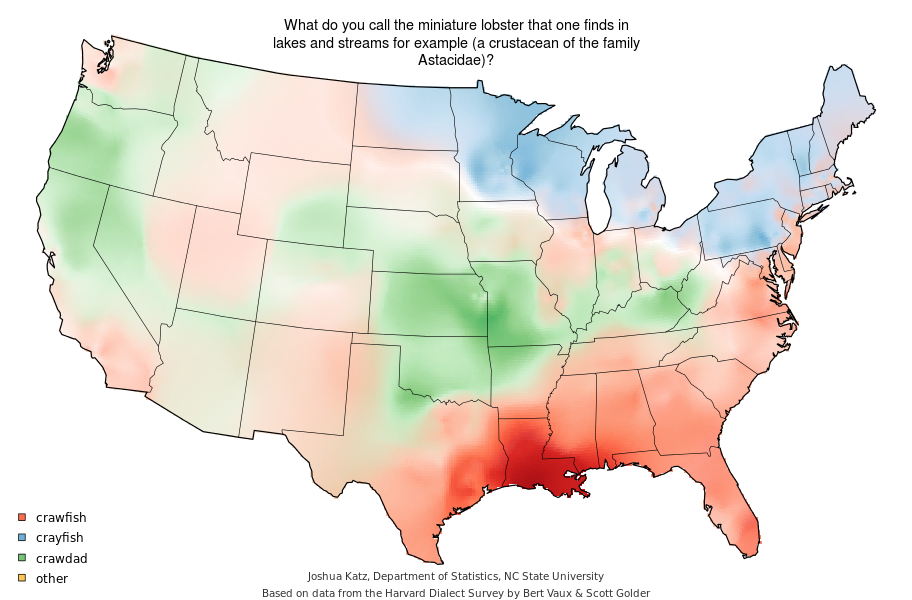
We also discussed regional dialects and mentioned a great website (http://spark.rstudio.com/jkatz/SurveyMaps/)  where you can compare how various words and phrases are used around the United States. Here is the map James referred to in the podcast concerning the use of the term crawdad or crayfish or crawfish.


Go here if you want to map the geographical origin of your own linguistic tendencies.

Interlude music within the podcast is "Maccary Bay" Kevin MacLeod (incompetech.com) Licensed under Creative Commons: By Attribution 3.0 http://creativecommons.org/licenses/by/3.0/

Season 1 Episode 2: Chapter I - Variation Under Domestication


This is episode 2 of the series and we read and discuss Chapter One from Origin of Species entitled Variation Under Domestication. We talked about the great diversity of pigeon breeds that Darwin was impressed with and used as a model to explain how selective breeding can create new varieties and forms. Scroll down on this website to see a nice slide show of Pigeon Breeds.


James made the claim that giraffe's necks are actually short compared to other herbivores in Africa and this photo shows a giraffe having to kneel to drink water where the zebras have no problem reaching the water with their long necks.
https://www.insidescience.org/news/how-do-giraffes-drink-water


The scientific paper that Sarah referenced concerning a current view of dog evolution can be found here.
 
Wired magazine wrote a nice summary of the cattle evolution story and it can be found here.


Interlude music within the podcast is "Vadodora Chill Mix" Kevin MacLeod (incompetech.com) Licensed under Creative Commons: By Attribution 3.0 http://creativecommons.org/licenses/by/3.0/

Welcome to the podcast

Welcome to the web resource to the Discovering Darwin Podcast. Each podcast episode is dedicated to a discussion of Charles Darwin and his writings. This first season will focus on Darwin's most famous work - The Origin of Species by Means of Natural Selection Or The Preservation of Favored Races in the Struggle for Life. If you listen to the podcast you will get to hear Josh's rendition of the complete title of the book. After the first episode, which is dedicated to "Who is Darwin and how did he come to his conclusions?", we will continue the podcast season by dedicating each episode to a chapter of the book. Within the podcast we will give a chapter summary using quotes from the text, then Sarah, Josh and James will have an informal conversation about the contents of the chapter and random aspects that intrigued us and then we will end the podcast with a contemporary scientific view of the ideas of the chapter, discussing where Darwin was right and where he may have been incorrect. 

To make it easy for you the listener to follow along with the conversation we all are using the Modern Library 6th edition of Origin of Species and make page references to that edition.Thanks for joining us and feel free to ask us questions which we will answer either through the blog or, if the topic deserves it, a secondary mini-podcast.
The cover of the hardback version of the Modern Library edition of The Origin of Species


The opening theme to Discovering Darwin is May by Jared C. Balogh. http://freemusicarchive.org/music/Balogh/Revitalized_Eyes/MAY
Copyright: Attribution-NonCommercial-ShareAlike: 

http://creativecommons.org/licenses/by-nc-sa/3.0/