Season 1 Episode 4 - Chapter III Struggle for Existence

This podcast episode is dedicated to Chapter III from Charles Darwin's Origin of Species. The title of the chapter is Struggle for Existence.  We discussed Thomas Malthus and how his ideas of population growth influenced Charles Darwin. In particular, Malthus noted that human population growth is geometric which is clearly represented by the graph below that shows global human population growth in the last 300+ years.  Human population on earth is currently over 7 billion with the estimates that in the next 50 years we may level off somewhere between 7-16 billion people, which is a large margin of error. The thought is that cultural norms and female education will decrease individual female fertility which will ultimately dampen global population growth.

If true and human population stabilizes it will be unusual since humans would be exhibiting self-regulation of their population instead of having external mortality factors (disease or predation) determining population size.

Graph summarizing human population growth.


Although Malthus was correct in his view of human population growth, his prediction about the rate of food availability being linear was wrong because modern agriculture has also shown a geometric increase in yield/acre by utilizing evolution (artificial selection in breeding newer varieties of crops) and fossil fuels to operate machinery, irrigate crops and manufacture fertilizers, pesticides and herbicides to increase crop yield. This phenomenon has been named the Green Revolution and it began in western cultures at the end of World War II. The graphs below show how increases in yield/acre for two food crops (corn and wheat) and two other crops (cotton and tobacco) have mirrored the geometric increase of human population growth.

Increase productivity in selected crops

One of the exciting ideas that Darwin introduces in this chapter is the idea of trophic cascades, the interaction between the various organisms in an ecosystem. We discussed Darwin's beautiful example of the complex indirect relationship between cats in a village and the population of clover in the fields. Recently a complex example has come to light when wolves were reintroduced to Yellowstone national park. The reintroduced wolves altered the foraging behavior of elk thereby reducing the elk negative impact on young tree recruitment which increased forest and understory growth. Increase in tree growth along the river banks stabilized the soil and reduced erosion which resulted in improved water quality and river flow.Ultimately the reintroduction of wolves influenced fish communities, beaver abundance and other indirect effects which are documented in detail in a variety of scientific papers which can be found at the Global Trophic Cascades research program website from Oregon State University. The researchers have linked a large number of their original research papers for free download.


From Ripple et al. (2014) Science 343
 If you do not feel like reading, then we recommend you watch the short but wonderful TED talk by George Monbiot as he describes some of the complex trophic cascades uncovered in different ecosystems.

Josh and Sarah brought up the idea of how invasive species can illustrate the importance of predators and disease in controlling population size since many invasive species can dramatically increase their population size when compared to their native population sizes in the land of origin.

We mentioned Josh's favorite study species the Hemlock Wooly adelgid (Adelges tsugae),  kudzu (Pueraria montana var. lobata)  and winter creeper, all of which are invasive in the eastern US.


Wooly adelgid image from http://www2.ca.uky.edu/

Kudzu image from http://www.forestryimages.org

Winter creeper image from http://www.local12.com


URL: http://freemusicarchive.org/music/Kevin_MacLeod/Best_of_2014_1461/Broken_Reality
Comments: http://freemusicarchive.org/
Curator:

Season 1 Episode 3: Chapter II - Variation Under Nature


In this episode of the podcast we explore Chapter II- Variation Under Nature from the 6th edition of Charles Darwin’s Origin of Species. One of the big themes Darwin explores in this chapter is the arbitrariness in defining a species and how to differentiate species from a variety or subspecies. 

Sarah brought up the example of ring species, in particular we talked about the herring gull species complex that circumnavigates the northern hemisphere. The ring species model (also called rassenkreis) of speciation was first developed in 1942 by Ernst Mayr (yes, the same Ernst Mayer mentioned by Josh) and it proposes that as a population disperses around a large scale geographical barrier (e.g., ocean, mountain ranges, etc) the sub-populations diverge genetically with distance from the ancestral original population. Ultimately when these sub-populations meet again on the other side of the barrier they have diverged so much as to become reproductively isolated. In our conversation we discussed the herring gull species complex and mentioned the salamander species complex from the California central valley as examples of ring species. More recent research has questioned if these two are actually examples of Mayr’s ring species model but instead are products of the standard allopatric speciation model which requires the populations to become reproductively isolated from the parental population and speciation occurs as the sub-population become adapted to their local environmental conditions. 

Regardless of the speciation model that is occurring, the herring gull complex exhibits a great array of interbreeding subpopulations that blurs the line between species and subspecies and it illustrates intermediate forms in the speciation process. The figure below is from a 2004 paper that challenges the view that the herring gulls are an example of a true rassenkreis.


Figure on the left represents the classic view, as described in our podcast, of how the herring gull species complex came about. The new alternative mode, figure on the right, reveals multiple origins, allopatric speciation events, and more complex dispersal patterns.


We also discussed Carl Linne’ (Linnaeus) and the organization scheme he proposed in 1735 that involves nested hierarchies: Kingdom > Phyla > Class > Order > Family > Genus > Species which we still use today.  James noted how Linnaeus looked like Ed Asner with a wig and questioned Linnaeus’ decision to use himself as the type specimen for all Homo sapiens.  

Modern Carl Linnaeus as portrayed by Ed Asner

Type specimen that represents all humans


In our conversation about how when species have a distribution that extend over great geographical ranges there are often local distinct geographical varieties.  James mentioned Bergmann’s rule which says that for endotherms (“warm blooded”) animals, they get larger as you move from the equator towards the northern latitudes. This beautiful poster (http://serchio25.deviantart.com/art/bear-species-73640712) illustrates the size shift northward in bears going from the equatorial Sun bears at 50 kg  to the arctic polar bear at 720 kg. The artist also included the extinct short-faced bear Arctodus simus yukonensis which is estimated to grow up to 975 kg in size.


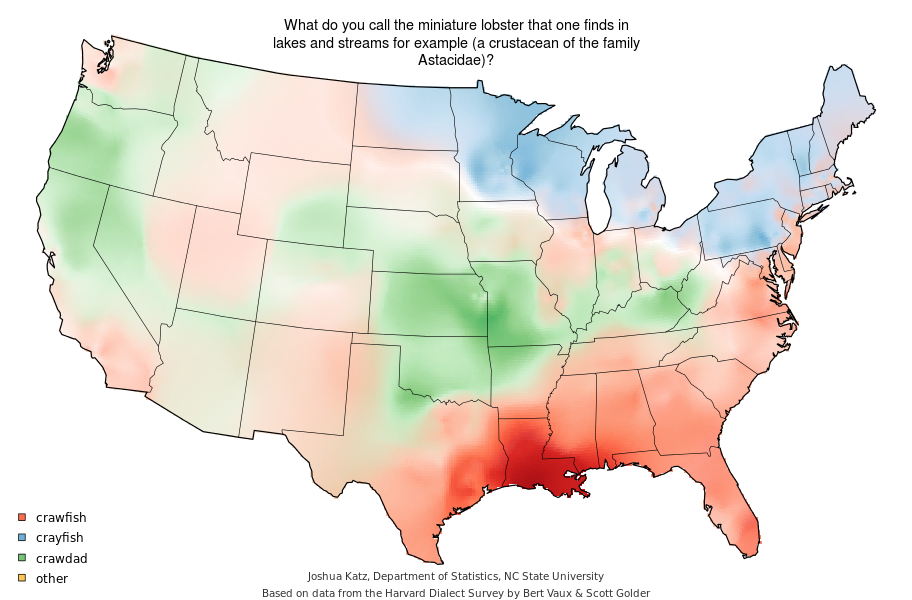
We also discussed regional dialects and mentioned a great website (http://spark.rstudio.com/jkatz/SurveyMaps/)  where you can compare how various words and phrases are used around the United States. Here is the map James referred to in the podcast concerning the use of the term crawdad or crayfish or crawfish.


Go here if you want to map the geographical origin of your own linguistic tendencies.

Interlude music within the podcast is "Maccary Bay" Kevin MacLeod (incompetech.com) Licensed under Creative Commons: By Attribution 3.0 http://creativecommons.org/licenses/by/3.0/